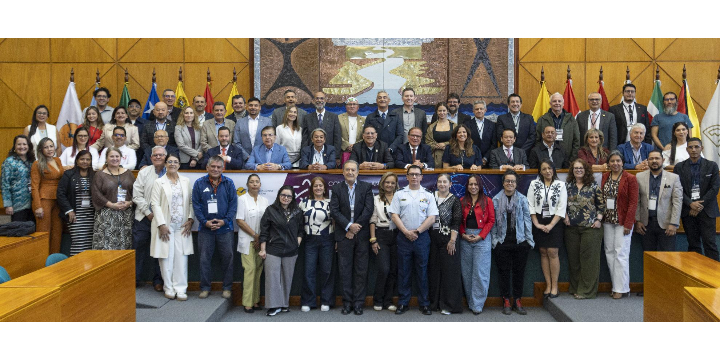
From 14 to 16 September 2026, Universidad Andina Simón Bolívar, Ecuador Campus, hosted the LAGPA 2026 Conference in Quito under the theme “Public Management and the Future of Latin American Economic Integration: Navigating Global Fragmentation and Regional Opportunities”.
The event was organised by the Latin American Group for Public Administration (LAGPA), together with Universidad Andina Simón Bolívar, Universidad del Valle—through its Institute for Foresight—and the Colombian College of Public Policy (CCPP), in conjunction with its Fifth Seminar. It received support from the International Institute of Administrative Sciences (IIAS), the International Association of Schools and Institutes of Administration (IASIA), and the Latin American and Caribbean Institute for Economic and Social Planning (ILPES) of ECLAC.
The conference brought together approximately 130 participants, both in person and online, from Ecuador, Colombia, Mexico, Brazil, Chile, Costa Rica, and Italy. Researchers, faculty members, postgraduate students and public administration professionals exchanged experiences and perspectives on institutional challenges and opportunities for cooperation in Latin America.
One of the main innovations of this edition was a new academic format based on a call for papers across fourteen thematic tracks. This approach combined paper presentations and specialised discussions with keynote lectures, broadening opportunities for participation within the academic community.
The tracks covered governance, local government, artificial intelligence and information technologies, economic and political integration, energy transition, bioeconomy, geopolitics, migration and social policies. They also addressed university management, infrastructure and markets, foresight and innovation, and smart cities and regions.
Another innovation was the interactive programme, accessible on mobile phones and computers through a link and a QR code. The tool let participants search for speakers and papers, check schedules and institutional affiliations, and filter activities by country, room, and session round, helping them navigate the conference.
The opening ceremony included institutional messages from IIAS and IASIA, reaffirming LAGPA’s ties with the international administrative sciences community.
The plenary hall activities were livestreamed, and recordings are available on YouTube through the conference website. These recordings allow the academic and professional community to revisit the presentations and discussions held in that venue.
Photographs from the conference are available in the Flickr photo album.
Follow-up activities include compiling reports from the thematic tracks and sharing the discussions through the LAGPA/IIAS dialogue series, extending the reach of the academic exchange held in Quito.